

Grace and Conflict in the Church Family: How to Walk Together When It Would Be Easier to Walk Away

This article is Week 16 of the Grace in Everyday Relationships Series.
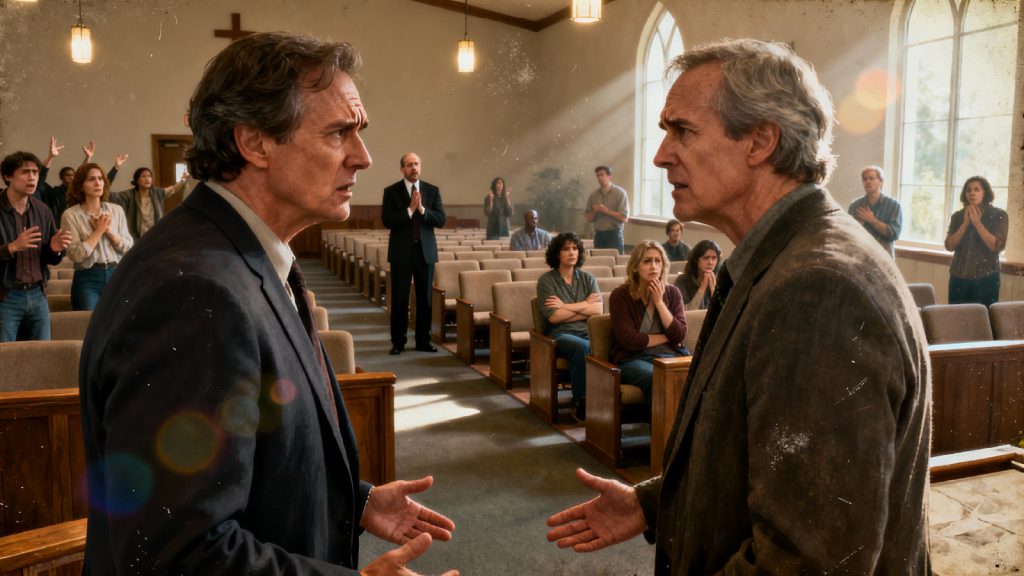
Church conflict is one of those subjects we hope we’ll never have to talk about—until we’re forced to.
Maybe you’ve felt your stomach tighten when you walked into the sanctuary and spotted someone across the aisle you’ve been avoiding. Maybe a conversation in the parking lot went sideways months ago, and you’ve never really recovered. Maybe you’ve changed small groups, service times, or even churches just to get away from tension.
If that’s you, hear this clearly: you are not alone, and you are not broken beyond repair. Conflict in the church is not proof that the gospel has failed. It is proof that the gospel is still very much needed.
In this post, we’ll explore how grace can shape the way we handle church conflict—so we can walk together like a real family instead of scattering whenever things get uncomfortable.
1. Remember Who the Church Really Is
When Paul urges the believers in Ephesians 4 to “walk in a manner worthy of the calling,” the very first area he talks about is relationships in the local body. He reminds them they share “one body and one Spirit… one Lord, one faith, one baptism.”
That means the people who frustrate you on Sundays are not random strangers. They are brothers and sisters purchased by the same blood that purchased you. The church is not a voluntary club of like‑minded people; it is a blood‑bought family.
When we forget this, it becomes very easy to treat church like a product. If a relationship or ministry becomes uncomfortable, we quietly think, “Maybe I’ll just find a place that fits me better.” But if these are brothers and sisters, the instinct shifts. Family works through conflict; consumers walk away from it.
A practical step: before you rehearse what “that person” did, pause and ask, “Who is this person in Christ? How does Jesus see them?” That question doesn’t erase sin, but it softens hard edges in our hearts.
2. Own Your Part Before You Point Fingers
James asks a piercing question: “What causes quarrels and what causes fights among you?” His answer is unsettling—“Is it not this, that your passions are at war within you?” There may indeed be real wrongs on the other side, but Scripture insists that we start by looking inside.
There is almost always something we wanted badly in the conflict: to be right, to be respected, to be in control, to be comfortable. Those desires rarely feel sinful to us, but they sit beneath our angry words, cold silence, or quick exit.
Jesus’ picture of the log and the speck is not about pretending the speck doesn’t matter. It’s about the order we take: deal first with the log in your own eye, then you’ll see clearly to help your brother with his speck.
Before you fire off that email, vent to a friend, or replay the conversation one more time, ask:
- What did I want so badly in that moment?
- How did I contribute—by words, tone, timing, or avoidance?
This doesn’t excuse genuine sin done against you. But it does position you as a fellow sinner in need of grace, not as a judge on a throne.
3. Speak the Truth in Love, Not as a Weapon
In many churches, conflict goes sideways not because the issue is impossible, but because we either avoid the truth or wield it like a hammer.
Paul calls us to “speak the truth in love” and to put away falsehood, speaking truth with our neighbors because we are members of one another. He also warns us that our words should “build up” and “give grace to those who hear.”
That means gossip and triangulation have no place in a church family. When we air grievances about someone to everyone except the person involved, we widen the fracture instead of healing it.
On the other hand, blurting out, “I’m just being honest,” while we cut someone down is not biblical truth‑telling either.
A grace‑shaped hard conversation might sound more like this:
- “When this happened, I felt hurt and confused.”
- “I value our relationship and want to understand what happened.”
- “Is there anything I’ve done that I’m not seeing?”
Notice the difference:
- It names the issue clearly.
- It takes responsibility for your own perspective.
- It invites dialogue rather than a verdict.
If you need to have a conversation like this, pray first. Ask the Lord to check your motives, guard your words, and give you a heart that aims at restoration, not victory.
4. Use Jesus’ Pattern, Not the World’s
Our culture has two main modes for handling conflict: blow up or back out. We either escalate the fight or disappear completely.
Jesus offers a third way in Matthew 18:
- Go privately to your brother or sister and talk about the fault.
- If they won’t listen, bring one or two others as wise witnesses.
- If they still won’t respond, involve the broader church (in serious, unrepentant cases).
Notice what’s missing: there is no step that says, “Tell everyone else and hope it gets back to them.” There is no step that says, “Post about it vaguely on social media.” There is no step that says, “Just leave and never talk to them again.”
This pattern doesn’t apply to every annoyance or preference. We don’t need a Matthew 18 meeting every time someone forgets your name or doesn’t pick your favorite worship song. But when there is real sin, or a serious breach of trust, Jesus’ pattern gives us a way to pursue peace rather than pretend or explode.
If you’re in conflict today, ask honestly: Have I followed Jesus’ pattern, or have I mostly followed my instincts?
5. Practicing Gracious Boundaries in the Church
Sometimes we imagine that loving our church means saying yes to every demand and staying in every setting, no matter what it does to our soul or our family. Scripture paints a more nuanced picture.
You are called to guard your heart. You are called, as far as it depends on you, to live at peace with all. Those commands acknowledge that you have limits—and that relational peace involves more than one person’s will.
Gracious boundaries might look like:
- Stepping out of a ministry role where persistent conflict has made you bitter, while you seek help and healing.
- Choosing not to engage in certain recurring debates that never bear good fruit.
- Limiting behind‑closed‑doors conversations with someone who repeatedly crosses relational lines, while still greeting them kindly and praying for them.
Boundaries are not about punishing others. They are about making honest assessments of what is wise and sustainable while you keep your heart open to Christ and your hands open to His people.
If you are exhausted and cynical, it may be time to talk with a trusted elder, pastor, or mature believer about whether some boundaries are needed—not as an excuse to withdraw from the body, but as a way to remain in the body with a whole heart.
6. Staying When It Would Be Easier to Leave
There are rare situations where, after prayer, counsel, and following biblical processes, a believer may need to leave a local church—especially in cases of persistent false teaching or entrenched, unaddressed abuse.
But far more often, we are tempted to leave over wounds and disappointments that could actually be places of growth if we stayed and worked through them.
Hebrews 10 calls us not to neglect meeting together, but to spur one another on and encourage one another “all the more as you see the Day drawing near.” That encouragement doesn’t only happen when things are smooth. It happens when we confess, forgive, repent, and reconcile, sometimes slowly.
When you stay and do the hard work of peacemaking:
- Younger believers watch and learn what covenant community looks like.
- Children see that church is more than a weekly event; it’s a family you don’t abandon at the first sign of tension.
- Your own character is stretched in patience, humility, and endurance.
Ask yourself honestly: “Am I wanting to leave because the Lord is clearly leading me elsewhere, or because I’m tired of doing the work of family?”
7. Hope: Jesus Walking Among Imperfect Churches
One of the most comforting pictures in Scripture comes at the beginning of Revelation. John sees Jesus walking among the lampstands—the churches. Those churches are a mixed bag. Some are faithful but weary. Some are doctrinally sound but loveless. Some are compromised. Some are suffering.
Yet Jesus is there.
He knows their works. He sees their love and their failures. He commends, corrects, warns, and promises. But He does not abandon His churches. He calls them “My” lampstands.
That means He sees your church, too. He sees the emails that sting and the words that heal. He sees the quiet repentance and the stubborn pride. He sees your tears over strained relationships and your longing for unity.
And He is not indifferent.
So as you reach the middle of the year and think about conflict in your church family, do not only see the mess. See your Savior—present, wise, patient, and committed to finishing the good work He began in you and in your local body.
One Simple Step This Week
Take a moment to ask the Lord three simple questions:
- Lord, where have I contributed to conflict in my church family this year?
- Is there one conversation You want me to have, or one apology You want me to offer?
- How can I pray specifically for my church’s unity and witness this week?
Write down what comes to mind. Share it with a trusted believer if that would help. Then, by God’s grace, take one step—just one—in the direction of peace.
Grace doesn’t promise that every conflict will resolve exactly how you want. But it does promise that no conflict is beyond the reach of the God who loved a broken, stubborn people and called them His own.