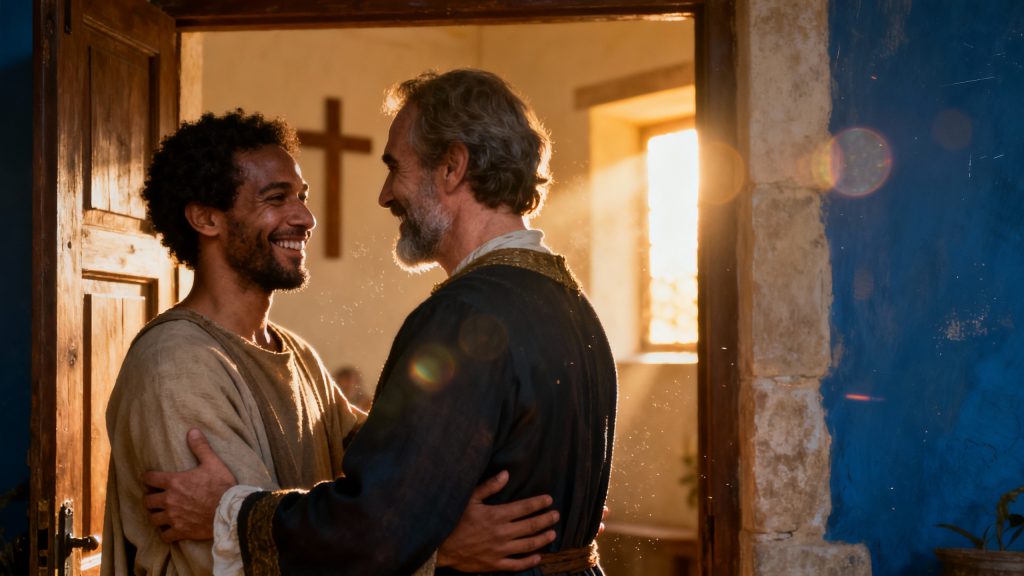

Ordinary Names, Extraordinary Grace


By the time we reach Colossians 4:7–18, Paul has already scaled the heights of Christology. He has proclaimed Christ as the image of the invisible God, the firstborn over all creation, the head of the body, the church, the One in whom all the fullness of God was pleased to dwell. This letter is saturated with high theology.
But the Spirit of God does something beautiful at the end: after the soaring doctrine comes a list of ordinary people. Tychicus. Onesimus. Aristarchus. Mark. Justus. Epaphras. Luke. Demas. Nympha. Archippus.
These aren’t abstract concepts; they are embodied lives. In these verses, we see a living illustration of the Body of Christ in motion—full of faithfulness and weakness, loyalty and failure, prayer and perseverance. Paul is not just “wrapping up”; he is modeling what gospel partnership looks like on the ground. And what emerges is a deep affirmation: ministry is never a solo project.
Faithful Messengers: Tychicus and Onesimus (Colossians 4:7–9)
Paul begins by commending two men who will physically carry this letter and represent his heart to the Colossian church.
“Tychicus will tell you all about my activities. He is a beloved brother and faithful minister and fellow servant in the Lord. I have sent him to you for this very purpose, that you may know how we are and that he may encourage your hearts, and with him Onesimus, our faithful and beloved brother, who is one of you.”
Tychicus: The Quietly Faithful Servant
Tychicus appears in several New Testament letters as a trusted coworker and courier. Paul describes him with three rich phrases:
- Beloved brother – he is not just a worker but family.
- Faithful minister – he serves with reliability and integrity.
- Fellow servant – he shares the same Master and the same mission.
Notice that his ministry is not flashy. His calling is to carry messages, communicate Paul’s situation, and encourage their hearts. In other words, he is a bridge of trust between an imprisoned apostle and a local congregation.
There is a quiet dignity here. Not everyone will preach from a platform. Not everyone will write Scripture. But the church cannot function without men and women like Tychicus—those who are reliable, relational, and willing to carry truth faithfully from one place to another.
Onesimus: A Story of Reconciliation
Then comes Onesimus, a name that carries an entire backstory. Elsewhere we learn that he had been a runaway slave, connected to a man named Philemon. Somewhere between his running and his returning, Onesimus met Christ through Paul’s ministry and became “more than a slave… a beloved brother.”
Now, imagine the scene: Onesimus returns to the region with Paul’s letter in hand, no longer simply as someone’s property, but as a full member of the family of God. Paul publicly calls him “our faithful and beloved brother, who is one of you.” That’s not a throwaway line; it is a public affirmation of his new identity and a subtle call to the church to receive him accordingly.
This is reconciliation in motion:
- A broken relationship
- A transformed heart
- A costly return
- A community called to forgive, restore, and re-embrace
Application: Support, Reconciliation, and the Power of Community
From Tychicus and Onesimus, the church today can draw out at least two invitations:
- Value the quiet, reliable servants. The kingdom moves forward on the shoulders of people who show up, carry burdens, share updates, and encourage hearts. Affirm them. Thank them. Honor them.
- Practice reconciliation that matches the gospel you preach. Onesimus is a living testimony that in Christ, past failures and social labels do not have the final word. Our churches must be places where returning prodigals are met with grace, where forgiveness is not theory but practice.
Fellow Workers: A Portrait Gallery of Gospel Partnership (Colossians 4:10–14)
Next, Paul opens the door and lets us glimpse a room full of coworkers. These few verses feel like walking through a hallway lined with portraits—each person bearing a different story, gifting, and spiritual trajectory.
Aristarchus: Loyal in Chains
“Aristarchus my fellow prisoner greets you.”
Aristarchus shows up in Acts as a companion of Paul, even enduring a riot in Ephesus and accompanying Paul on dangerous journeys. By the time of this letter, he is sharing Paul’s imprisonment. He is not famous. There is no book of “Aristarchians.” But heaven knows his name. He is the friend who stayed when things got costly.
Mark: A Story of Restoration
“…and Mark the cousin of Barnabas (concerning whom you have received instructions—if he comes to you, welcome him).”
This is the same Mark who once abandoned Paul and Barnabas on a missionary journey, causing a sharp disagreement between them. But now, years later, Paul is not only working with Mark again—he is publicly commending him and making sure the Colossians “welcome him.” This is gospel restoration. Failure did not disqualify Mark forever; grace rewrote the story.
Jesus (Justus): A Quiet Encouragement
“And Jesus who is called Justus. These are the only men of the circumcision among my fellow workers for the kingdom of God, and they have been a comfort to me.”
We know almost nothing else about Justus, but we know this: as a Jewish believer standing with Paul in a difficult season, he was a comfort. Sometimes your ministry is not your title but your presence.
Epaphras: The Wrestling Intercessor
“Epaphras, who is one of you, a servant of Christ Jesus, greets you, always struggling on your behalf in his prayers, that you may stand mature and fully assured in all the will of God.”
Epaphras is likely the one who first brought the gospel to Colossae. Now he is away from them, but he has not let them go. Paul says he is “always struggling” or “wrestling” in prayer for them. This is pastoral ministry at its deepest level—not just organizing and teaching, but agonizing before God for the spiritual maturity of people.
Luke: The Beloved Physician
“Luke the beloved physician greets you.”
Here stands a reminder that God uses professionals, artisans, and everyday vocations for kingdom purposes. Luke was a doctor, a historian, a careful writer—and God used his skills to give us a Gospel and the book of Acts. Not every calling is “church staff,” but every calling can be kingdom service when yielded to Christ.
Demas: A Subtle Warning
“…as does Demas.”
The mention is brief and neutral here. Elsewhere, later, we read the heartbreaking note that Demas “in love with this present world” deserted Paul. At this moment in Colossians, Demas is still in the room. Still in the circle. Still listed with the workers.
This is a sober reminder: proximity to ministry is not the same as perseverance in Christ. We must guard our hearts, not just our roles. Today’s coworker can become tomorrow’s cautionary tale if the love of the world quietly takes root.
Application: Diversity, Restoration, and Perseverance in Community
This gallery of names invites the church to:
- Celebrate diverse callings. Prisoners and physicians, preachers and intercessors, couriers and comforters—all are needed.
- Leave room for restoration. Mark’s story shows that past failure need not be final. The church must hold truth and second chances together.
- Stay spiritually awake. Demas warns us that no one is above drifting. Our love for Christ must be nourished, not assumed.
Instructions for the Churches: Connected, Hospitable, and Faithful (Colossians 4:15–17)
Paul now lifts his eyes from individuals to congregations.
“Give my greetings to the brothers at Laodicea, and to Nympha and the church in her house. And when this letter has been read among you, have it also read in the church of the Laodiceans; and see that you also read the letter from Laodicea. And say to Archippus, ‘See that you fulfill the ministry that you have received in the Lord.’”
Interconnected Congregations
First, Paul sends greetings to the believers in Laodicea and mentions a church that meets in Nympha’s home. This is early church life: local congregations scattered across cities, connected by relationships, letters, and shared leadership.
The instruction to circulate the letters shows that teaching was meant to be shared, tested, and heard widely. There is a sense of accountability and unity in doctrine—churches are not isolated islands, but members of a larger body.
Nympha and Gospel Hospitality
Nympha is briefly mentioned, but her contribution is costly and concrete: she opens her home for the church to gather. In a world without dedicated church buildings, hospitality became infrastructure for the gospel.
Today, when homes open for small groups, prayer meetings, and discipleship, they are standing in the stream of Nympha’s legacy. Hospitality is not just “being nice”; it is making space for the people of God to grow together.
Archippus and the Call to Finish Well
“Say to Archippus, ‘See that you fulfill the ministry that you have received in the Lord.’”
We are not told what Archippus’s specific ministry is, but we are told that it came “in the Lord” — it is a calling given by Christ Himself. Paul’s words sound like a gentle but firm pastoral nudge: Don’t drift. Don’t stall. Lean in and complete what God has entrusted to you.
Every believer, not just pastors, has some measure of entrusted ministry:
- A family to shepherd
- A class to teach
- A workplace to influence
- A neighbor to love
- A gift to steward
And the call still stands: fulfill the ministry you have received.
Application: Active Participation and Mutual Support
For the modern church, these verses remind us:
- We are healthiest when our churches know, support, and learn from one another—not competing, but collaborating.
- Hospitality—opening homes, hearts, and schedules—is one of the quiet engines of spiritual growth.
- Each believer is not a spectator but a steward. There is a ministry entrusted to you; your church needs you to lean into it.
Paul’s Final Lines: Chains, Ink, and Grace (Colossians 4:18)
“I, Paul, write this greeting with my own hand. Remember my chains. Grace be with you.”
In a world where letters were often dictated to a scribe, Paul ends by taking the pen himself. This final line is personal, costly, and tender.
A Personal Signature
“I, Paul…” reminds the Colossians: behind the theology is a real man who loves them. A leader who prays for them. A shepherd who is suffering for the very gospel he is urging them to live out.
There is a lesson here for everyone in leadership: people need our doctrine, but they also need our humanity. Our willingness to be known, to be vulnerable, to sign our names to the things we teach.
Remember My Chains
Paul’s chains are not a bid for sympathy; they are a reminder of the cost of the gospel. He is in prison not for wrongdoing but for faithfulness.
“Remember my chains” calls the church to:
- Pray for those who suffer for Christ.
- Remain steadfast when the faith becomes costly.
- See suffering not as a sign of God’s absence, but as often the context of His most powerful work.
Grace Be With You
And then, as always, Paul ends with grace. The letter began with grace and peace; it ends with grace as their ongoing atmosphere. For all the exhortations, commands, and examples, the final note is not: “Try harder,” but:
“May the unearned favor of God go with you, sustain you, and surround you.”
We extend to others what we are constantly receiving from Christ. To live as the people described in this passage—to reconcile like Onesimus, to pray like Epaphras, to persevere like Aristarchus, to restore like Paul with Mark—requires a continual stream of grace.
Application: Extending Grace and Supporting the Persecuted
These closing words move us to:
- Extend grace to one another: forgiving, restoring, and bearing with each other in love.
- Remember and support the persecuted church: through prayer, advocacy, and sacrificial generosity.
Three Social Media Hooks
Hook 1 – “The Names at the End of the Letter”
“Ever skim the names at the end of Paul’s letters? Colossians 4:7–18 is more than a list—it’s a living picture of real friendships, failures, restorations, and prayers that powered the early church. This week’s blog unpacks the stories behind the names and what they mean for our church family today. Read it online, then join us Sunday as we step into this kind of community together.”
Hook 2 – “Your Name Could Be in This List”
“If your life were written into a page of Scripture, what would the single sentence say about you? In Colossians 4, Paul describes people as ‘beloved,’ ‘faithful,’ ‘prayerful,’ and even ‘a comfort to me.’ Our new article explores these real people and how God used their ordinary lives. Read it, then come Sunday as we discover how our names can reflect the same grace and calling.”
Hook 3 – “From Runaway to Brother, From Failure to Faithful”
“A runaway slave restored. A failed servant given a second chance. A doctor, a prayer warrior, a friend in chains. Colossians 4:7–18 is full of stories that sound a lot like ours. This week’s blog walks through these closing verses and shows why they matter more than we think. Check it out, then gather with us Sunday morning as we go deeper and ask God to write His grace into our relationships too.”