
The Man No One Would Have Chosen: When Grace Stops You in Your Tracks

A study of Acts 9:1–19a — the conversion of Saul
Every church has a name it flinches at. There’s a person so hard, so angry, or so far gone that, if you’re honest, you’ve quietly filed them under “hopeless.” You’ve prayed for a lot of people. But not really for them. Somewhere along the way, you crossed them off your list.
The first church had a name like that too. The name was Saul of Tarsus.
Saul wasn’t a small-time critic. He was the most dangerous man alive for a Christian to meet. He had watched Stephen die and approved of it. He had gone house to house, dragging believers off to prison. And when we meet him in Acts 9, he isn’t slowing down. He’s asking for legal papers so he can hunt Christians in a city 135 miles away and bring them back in chains.
If you had asked the believers in Jerusalem, “Who is the one person God will never save?” — many of them would have said Saul.
Which is exactly why God chose him.
Here’s the big idea we’re going to walk through: God’s grace can change the worst enemy of the gospel into a chosen servant for His glory. No one is too far gone. Let’s watch it happen.
Scene 1: The Hunter on the Road (Acts 9:1–2)
“Now Saul, still breathing threats and murder against the disciples of the Lord, went to the high priest, and asked for letters from him to the synagogues at Damascus, so that if he found any belonging to the Way, both men and women, he might bring them bound to Jerusalem.” (Acts 9:1–2, NASB95)
Luke doesn’t ease us into this. The very first thing we learn about Saul is that he was “breathing threats and murder.”
That word “breathing” is worth a pause. In Greek it’s empneōn. It paints a picture of Saul breathing in and out like it was the air in his lungs. Threat and murder weren’t a bad mood he was in that day. They were his whole climate. This is who he was.
Notice who he’s chasing: people who belonged to “the Way.” That was the first nickname the early Christians used for themselves — followers of Jesus, who said, “I am the way” (John 14:6). Saul was ready to travel almost a week on foot to arrest them.
Here’s the first thing to see: being sincere is not the same as being saved. Saul was as religious and serious as a person can be. He thought he was serving God. And he was completely, dangerously wrong. Sincerity pointed in the wrong direction is still the wrong direction.
So keep that name in your mind — the person you’ve written off. Watch what God is about to do.
Scene 2: The Hunter Gets Hunted (Acts 9:3–9)
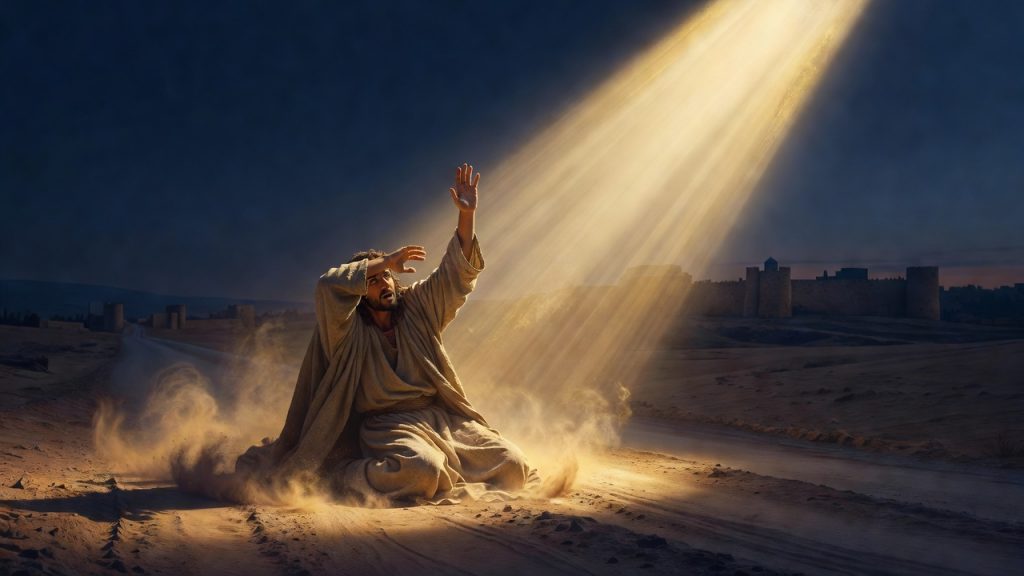
“As he was traveling, it happened that he was approaching Damascus, and suddenly a light from heaven flashed around him; and he fell to the ground and heard a voice saying to him, ‘Saul, Saul, why are you persecuting Me?'” (Acts 9:3–4, NASB95)
Saul is the hunter. He has the letters, the power, and the momentum. And then heaven cuts in. A light brighter than noon flashes around him, and the man who came to tie others up is thrown flat on the ground.
Look closely at what the voice says. Not “Why are you hurting My people?” but “Why are you persecuting Me?”
That word “persecuting” is diōkeis in Greek. It’s a hunting word — to chase down, to run after. And here’s the beautiful irony: the hunter has been hunted and caught by the very One he was chasing. Later, Paul takes that same word and aims it at Jesus: “I press on [diōkō] toward the goal” (Philippians 3:14). Grace didn’t erase Saul’s drive. It turned it around.
But don’t miss the main point. When you hurt the church, Jesus takes it personally. He and His people are that closely joined. Saul thought he was fighting a small religious group. He was fighting the risen Lord.
Saul answers, “Who are You, Lord?” (Acts 9:5). Isn’t that something? He calls the voice “Lord” before he even knows who it is. Deep down, he already knows he’s on the ground before someone greater than himself.
“Saul got up from the ground, and though his eyes were open, he could see nothing… And he was three days without sight, and neither ate nor drank.” (Acts 9:8–9, NASB95)
The proud man who set out leading an armed group is now led into the city by the hand, like a small child. For three days he sits in the dark. No sight. No food. No water.
Three days. In the Bible, that’s the time in the grave before a resurrection. Saul is buried in darkness, waiting for new life to break.
By the way — the text never mentions a horse. “Saul fell off his horse” comes from famous paintings, not from Luke. It’s a good reminder to trust what the Bible actually says over the pictures in our heads.
Here’s what this scene teaches: salvation starts with God, not with us. Saul wasn’t looking for Jesus. He was headed the other way with murder in his heart. Jesus found him. He did not find Jesus.
Scene 3: The Scared Messenger (Acts 9:10–16)
God is going to save Saul. But watch how He does it — through a plain, frightened believer.
“Now there was a disciple at Damascus named Ananias; and the Lord said to him in a vision, ‘Ananias.’ And he said, ‘Here I am, Lord.'” (Acts 9:10, NASB95)
Ananias isn’t an apostle. He’s just an ordinary Christian in Damascus. And when the Lord calls his name, his answer is perfect: “Here I am, Lord.”
Then he hears the assignment. Go find Saul.
“But Ananias answered, ‘Lord, I have heard from many about this man, how much harm he did to Your saints at Jerusalem…'” (Acts 9:13, NASB95)
You can hear the fear in his voice. “Lord, do You know who this is? This is the man with the arrest warrant. My name might be on it.” His fear isn’t silly. It’s reasonable.
And here’s the tender part: God doesn’t scold him. God just gives him a bigger view of what He’s doing.
“But the Lord said to him, ‘Go, for he is a chosen instrument of Mine, to bear My name before the Gentiles and kings and the sons of Israel…'” (Acts 9:15, NASB95)
“A chosen instrument.” In Greek that’s skeuos eklogēs — literally, “a vessel of choosing.” A skeuos is a container, a tool, a clay pot. It’s only useful because of what the owner puts in it and does with it.
That picture protects us from both pride and despair. Saul isn’t chosen because he’s impressive. A clay pot doesn’t choose itself or fill itself. Paul later uses the same word: “We have this treasure in earthen vessels [skeuos], so that the surpassing greatness of the power will be of God and not from ourselves” (2 Corinthians 4:7). God picks cracked clay pots on purpose, so the credit goes to Him.
Notice two things God ties to this call. First, a purpose: Saul will carry Christ’s name to every kind of person. Second, a cost: “I will show him how much he must suffer for My name’s sake” (Acts 9:16). The man who caused so much pain will now suffer for Jesus. Grace saves us for a mission — and the mission isn’t always easy.
So don’t miss your job in this story. God still saves hard people through ordinary believers who obey. Be a willing Ananias. Your nervousness makes sense. Go anyway.
Scene 4: Scales, Sight, and a Brand-New Life (Acts 9:17–19a)
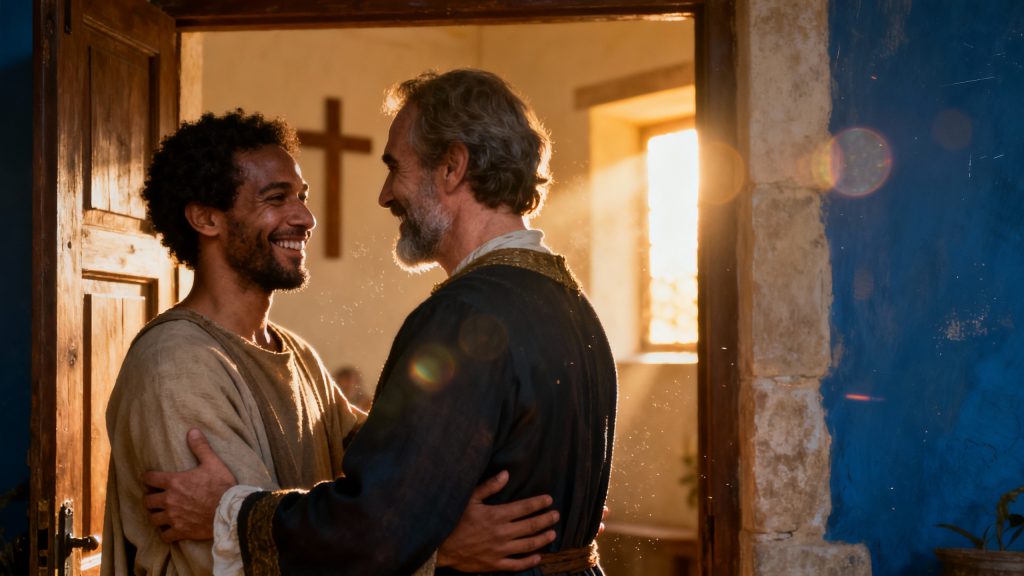
“So Ananias departed and entered the house, and after laying his hands on him said, ‘Brother Saul…'” (Acts 9:17, NASB95)
Ananias obeys. He walks into that house. And the first word out of his mouth is the word that changes everything: “Brother.”
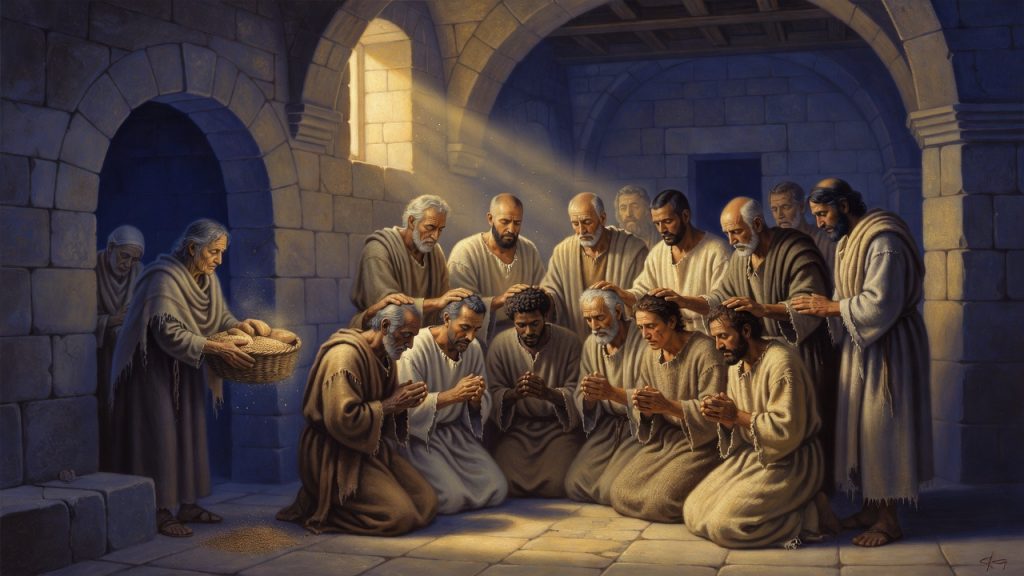
Yesterday’s enemy is today’s family. That one word is the whole gospel in a nutshell. The same grace that saved Ananias has now saved Saul, so Ananias can call him “brother.”
“And immediately there fell from his eyes something like scales, and he regained his sight, and he got up and was baptized; and he took food and was strengthened.” (Acts 9:18–19a, NASB95)
Luke was a doctor, and he uses a precise word here: lepides, “scales,” like the scales of a fish. Something like scales falls from Saul’s eyes, and he can see.
It’s more than a healing. It’s a living picture. The man who was spiritually blind — who looked right at the risen Jesus and saw only a threat — can finally see clearly. As Paul would later write, “God… has shone in our hearts to give the Light of the knowledge of the glory of God in the face of Christ” (2 Corinthians 4:6).
Then, right away, Saul is baptized. That’s the pattern all through Acts: believe, then be baptized. Baptism doesn’t save you, but it’s the public sign that says, “I belong to Jesus now.” He eats. He’s strengthened. The three-day burial is over. New life has begun.
The hunter has become a disciple.
What This Means for You and Me
1. No one is beyond the reach of grace. If Jesus can save the man breathing murder against His church, then no one on your prayer list is too far gone. Stop deciding ahead of time who can’t be saved. The greatest missionary in history was, the day before, the church’s worst enemy.
2. Your salvation started with God. Saul didn’t decide to give his heart to Jesus. Jesus grabbed hold of Saul on a road where Saul wanted nothing to do with Him. “You did not choose Me but I chose you” (John 15:16). That’s not a cold idea. It’s the warmest comfort there is. Your safety doesn’t rest on how tightly you hold God. It rests on how tightly He holds you.
3. Grace saves you for a mission. God made Saul a chosen vessel to carry His name. He saves us the same way — not to sit on a shelf, but to carry Jesus into our homes, our jobs, and our city. And He sends the gospel to every kind of person: every race, every background, every class. A church that truly gets grace will welcome the very people the world pushes away.
A Moment to Reflect
Take these questions slowly. Maybe write your answers down.
- Who is the “Saul” in your life — the person you’ve quietly decided is hopeless? What would change if you started praying for them by name?
- Do you rest more in your grip on God, or in His grip on you? How does Acts 9 speak to that?
- Ananias was scared but obeyed. Is there someone God may be nudging you to reach out to? What’s holding you back?
- Think about your own “scales.” What did Jesus open your eyes to see? How would you tell that story in a few sentences?
This Week’s Reading Plan
Spend a few minutes each day with these passages. They all trace the same theme: grace that reaches, saves, and sends.
- Monday — Acts 9:1–19a (Read the whole story slowly again.)
- Tuesday — Acts 8:1–4 (Meet Saul the persecutor — and see how God used the scattering.)
- Wednesday — 1 Timothy 1:12–17 (Paul calls himself the “foremost” of sinners and a pattern of mercy.)
- Thursday — Philippians 3:4–9 (Everything Saul was proud of, he counts as loss for Christ.)
- Friday — Galatians 1:11–24 (Paul tells the story of his own calling by grace.)
- Saturday — 2 Corinthians 4:1–7 (The light in our hearts; treasure in clay jars.)
- Sunday — John 15:12–17 (“You did not choose Me but I chose you.”)
Come and Respond
If you don’t yet know Christ: Maybe you walked in sure you’re the exception — too skeptical, too sinful, too far down the road. Look again at Saul. The same Jesus who met a murderer on the Damascus Road is near to you right now. He isn’t here to shame you. He’s here to call you. Our biggest problem isn’t out there; it’s the sin in here, against a holy God. But Jesus lived the life we couldn’t live, died the death we deserved, and rose again — and He offers you forgiveness and a fresh start. Turn from going your own way. Trust Him. If your heart is being pulled even now, don’t push it away.
If you already follow Jesus: Lay down the tired habit of holding on by your own strength — He chose you, and He holds you. Repent of the quiet verdict that certain people are hopeless, and start praying for your “Saul.” And when God says “go” to someone hard or unlikely, say yes.
Next Sunday we’ll pick up the story in Acts 9:19b–31, “From Persecutor to Preacher.” Within days of his conversion, Saul is standing in the synagogues telling everyone that Jesus is the Son of God. Grace that truly saves is grace that sends. You won’t want to miss it.
Join Us This Sunday
We’d love to worship alongside you as we open God’s Word together.
Sunday, August 2, 2026 — 11:00 AM Priceville Baptist Church 713 North Feemster Lake Road • Tupelo, Mississippi 38804
Part of “A Forty-Week Journey Through the Book of Acts.”