
In the Name of Jesus: Power for Healing and Witness

Have you ever stood in front of someone who was hurting and felt completely helpless? Maybe a friend was going through something painful and you didn’t have the right words. Maybe someone in your family needed help you just couldn’t give. You wanted to fix it, but your hands were empty.
That’s exactly where two of Jesus’ closest followers found themselves one afternoon in Jerusalem. Peter and John were on their way to the temple to pray. They didn’t have money. They didn’t have political power. They didn’t have a plan to change the world that day. But they had something far greater than anything money could buy. They had the name of Jesus Christ — and that name was about to change a man’s life forever.
This week in our journey through the book of Acts, we come to one of the most powerful stories in the early church. In Acts 3:1–10, we watch as a man who had never taken a single step in his life is healed instantly — not by medicine, not by money, but by the authority of Jesus’ name spoken through ordinary believers.
Last week, in Acts 2:42–47, we looked at the marks of a healthy church. We saw how the first Christians devoted themselves to teaching, fellowship, breaking bread, and prayer. We saw a community filled with the Holy Spirit and growing every day. But a healthy church doesn’t just gather — it goes. And when it goes out into the world, it carries the most powerful name in the universe.
Today, we step outside the walls of that early church and see what happens when Spirit-filled believers meet a broken world.
An Ordinary Moment Becomes a Divine Appointment
The story begins with something completely normal. Peter and John went to the temple at about three o’clock in the afternoon. This was one of the regular Jewish times of prayer. Even though the Holy Spirit had filled them at Pentecost, they hadn’t stopped practicing the daily discipline of worship and prayer. The Spirit’s power doesn’t replace faithfulness — it fuels it.
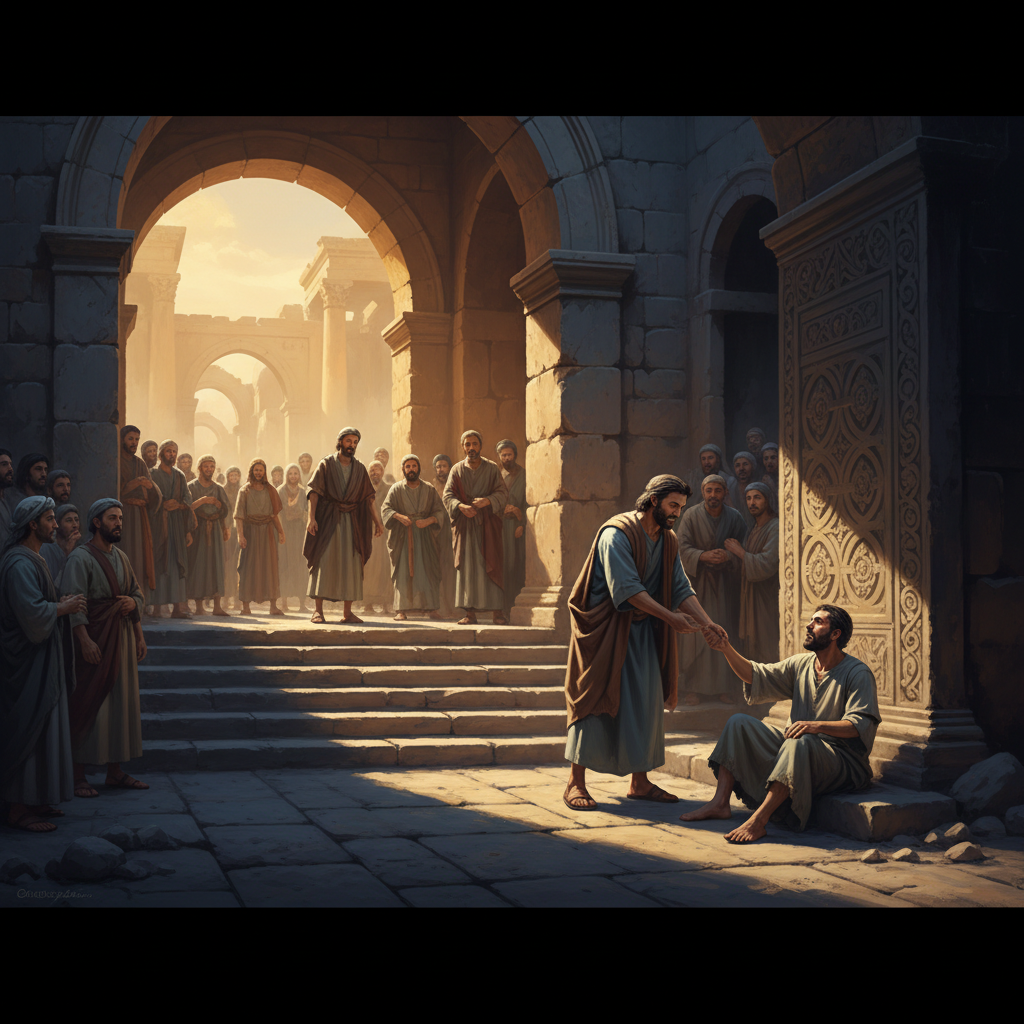
At the temple gate called Beautiful sat a man who had been lame from birth. Every single day, someone carried him to that spot so he could beg for money. Think about that for a moment. He sat at the entrance to the most beautiful part of God’s house, but he could never fully enter in. He was close to the place of worship, but far from its promises. Luke, the author of Acts, paints a powerful picture here: beauty and brokenness, side by side.
When the man saw Peter and John walking toward the gate, he did what he always did. He asked for money. He expected a coin or two — maybe nothing at all. He had no idea that this ordinary afternoon was about to become the most important moment of his entire life.
Here’s what we need to see right away: God often works through our everyday routines. Peter and John weren’t out looking for a miracle. They were simply being faithful in their daily walk with God. But because they showed up to pray, God set up something extraordinary. We need to stop thinking that God only works in big, dramatic moments. He works in the daily faithfulness of His people — your commute, your lunch break, your walk through the neighborhood.
How many people do you walk past every day who are stuck, broken, and sitting at the gate of something beautiful but unable to enter in? God may be setting you up for a divine appointment this very week.
“Evening and morning and at noon I will pray, and cry aloud, and He shall hear my voice.” — Psalm 55:17
What We Have Is Greater Than What We Lack
What happens next is one of the most memorable moments in all of Scripture.
Peter stops. He looks right at the man. He says, “Look at us.” In a world where people walked past beggars without a second thought, Peter sees a person — not a problem. Before the miracle happens, there is dignity. Before the power is displayed, there is presence. Peter treats this man as someone made in the image of God and worthy of his full attention.
Then Peter says something honest: “I have no silver and gold.” He doesn’t pretend to have what he doesn’t have. The early church wasn’t wealthy. But Peter’s empty pockets weren’t a problem — they were a setup. When you have nothing the world values, you discover what the world truly needs.
And then come the words that change everything:
“In the name of Jesus Christ of Nazareth, rise up and walk!” — Acts 3:6
This is not a magic formula. In the Bible, a person’s name represents their authority, character, and power. To act “in the name of Jesus” means to act under His authority and by His power. Peter is not the source of this healing. Jesus is. Peter is simply the servant who speaks the Master’s word.
Notice the full title Peter uses: “Jesus Christ of Nazareth.” He doesn’t point to a vague spiritual idea. He names a specific, real, historical person — Jesus, the Messiah, from the small town of Nazareth. The power behind this miracle is personal. It is rooted in a real Savior who lived, died, and rose again.
The Apostle Paul would later write that God “highly exalted him and bestowed on him the name that is above every name” (Philippians 2:9). That’s the name Peter speaks over this broken man. That’s the name that still carries authority today.
Here is a truth the church needs to hear again and again: Our greatest asset is not our budget, our building, or our programs. It is the name of Jesus Christ. We live in a culture that measures value by dollars, influence, and platform. Peter flips that entire script. What we have to offer the world isn’t what the world expects — but it’s exactly what the world needs.
When we pray “in Jesus’ name,” we are calling on the authority of the risen King. We don’t mumble it as a closing formula tacked onto our prayers. We speak it with real faith in the One who holds all authority in heaven and on earth.
“We have this treasure in jars of clay, to show that the surpassing power belongs to God and not to us.” — 2 Corinthians 4:7
A Transformation That Cannot Be Denied
What happens next is breathtaking in its speed and completeness.
Peter reaches down and takes the man by his right hand. There is physical contact — a point of real human connection. The gospel is not a theory delivered from a safe distance. It’s good news carried by people who are willing to get close to the broken.
The moment Peter lifts the man up, his feet and ankles receive strength. Luke, who was a physician, uses precise medical language here. Bones, tendons, and muscles that had never worked properly in this man’s entire life are made whole in an instant. This is not a slow recovery. This is not physical therapy. This is the unmistakable fingerprint of God’s power.
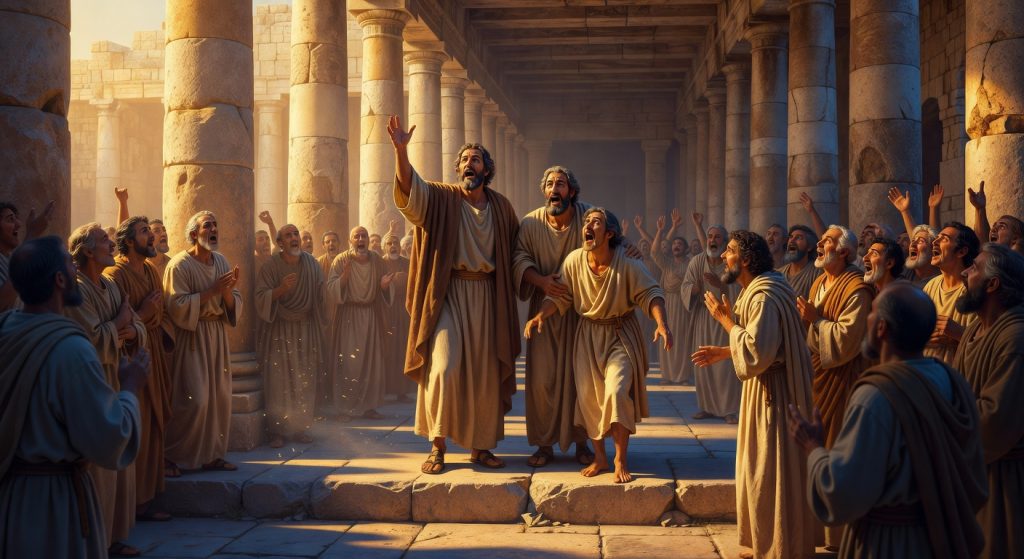
And the man doesn’t quietly stand up and dust himself off. He leaps. He walks. He praises God. He enters the temple — the very place he had been sitting outside of for years. His body, his location, and his worship are all transformed in a single moment.
The order matters: walking, leaping, praising God. Physical healing leads to joyful expression, which leads to worship of the One who healed him. He doesn’t praise Peter. He praises God. The miracle points his attention upward — not to the instrument, but to the Source.
The prophet Isaiah had written centuries earlier that one day “the lame man shall leap like a deer” (Isaiah 35:6). That messianic promise is being fulfilled right here, through the apostles, in the name of Jesus. The signs of God’s promised kingdom are breaking through.
And the miracle is completely public. Everyone in the temple courts recognizes this man. They know he was the beggar at the Beautiful Gate. There is no way to explain it away. The transformation is obvious, and it creates an immediate opportunity for the gospel to be shared. The crowd is “filled with wonder and amazement” (Acts 3:10). Their astonishment opens a door for Peter to preach his second major sermon — which we’ll study next week in Acts 3:11–26.
When Christ transforms a life, the evidence is public. You can’t hide a changed life any more than this man could hide the fact that he was leaping for the first time. The way you handle suffering, love people who are different from you, and forgive when forgiveness costs you something — all of it is a witness that points people to Jesus.
“One thing I know, that though I was blind, now I see.” — John 9:25
What This Story Means for Us Today
This is not just an ancient story about a miracle in Jerusalem two thousand years ago. It carries truths that speak directly into our lives right now.
First, we offer what we have — the name of Jesus — not what we don’t have. We may not have impressive resources or cultural influence. Priceville Baptist Church is not a megachurch. But we have the name of Jesus. That name carries more authority than any institution, more power than any government, and more hope than any program the world can offer. Our job is not to impress people with what we have. It’s to introduce them to the One who has everything. As David told Goliath long ago, “I come to you in the name of the LORD of hosts” (1 Samuel 17:45).
Second, everything we do should point people to Christ, not to us. Peter never draws attention to himself. In the very next scene, when the crowd stares at him in awe, Peter immediately says, “Why do you stare at us, as though by our own power or piety we have made him walk?” (Acts 3:12). Every good work God does through our hands should redirect attention to Jesus. We are not the heroes of this story. He is.
Third, physical healing points to a far greater spiritual healing. The lame man received strong ankles. But his deepest need — like every person’s deepest need — was spiritual wholeness. Sin has crippled every single one of us. We are spiritually lame, unable to walk into God’s presence on our own. But in the name of Jesus, we are raised up, made strong, and brought into the Father’s house. As Paul writes, “You were dead in trespasses and sins… but God made us alive together with Christ” (Ephesians 2:1, 5). The miracles in Acts are signposts pointing to the greatest miracle of all: dead hearts made alive by the power of Christ.
A Moment for Reflection
Before you move on, take a moment to sit with these questions. Let the Holy Spirit speak to your heart.
- Are you trying to help people in your own strength and your own name — when what they really need is Jesus?
- Is there someone in your life right now who is “sitting at the gate,” broken and stuck, and God is asking you to stop, look at them, and offer them the hope of Christ?
- Have you been walking past people every day without seeing them — really seeing them — the way Peter saw the lame man?
- Do you believe that what God has placed in your hands — His name, His Spirit, His truth — is enough, even when the world says you need more?
Take a moment right now to pray. Ask God to open your eyes to the people around you and to give you the boldness to offer them the only name that can truly heal.
Suggested Scripture Readings for This Week
Use these passages for personal devotion or family worship to go deeper into this week’s themes:
- Monday: Acts 3:1–10 — Read the full passage again slowly. Ask the Spirit to show you something new.
- Tuesday: Philippians 2:5–11 — The name above every name. Meditate on the authority of Jesus.
- Wednesday: 2 Corinthians 4:7–12 — Treasure in jars of clay. Reflect on God’s power working through your weakness.
- Thursday: Isaiah 35:1–10 — The messianic promise of healing and restoration. See how Acts 3 fulfills this vision.
- Friday: John 14:12–14 — Jesus promises that His followers will do great works in His name. What does that look like for you?
- Saturday: Ephesians 2:1–10 — From spiritual death to life in Christ. The greatest healing of all.
- Sunday: Acts 3:11–26 — Preview next week’s text as Peter uses this miracle to preach the gospel to the crowd.
A Call to Action
This passage doesn’t let us sit comfortably as spectators. It calls us to respond. Here are four ways to put this week’s truth into practice:
1. Pray daily: “Lord, use what I have.” Each morning this week, before you start your day, pray this simple prayer: “Lord, I don’t have much to offer. But what I have — Your name, Your Spirit, Your truth — I give freely. Use me today.” Stop measuring your usefulness by what you lack and start trusting God with what He’s already placed in your hands.
2. See the person, not just the problem. Peter looked at the lame man and truly saw him. This week, slow down and notice the people around you. Make eye contact. Learn a name. Ask a question. Before you can share the gospel with someone, you need to see them as a person made in the image of God.
3. Offer Jesus, not just advice. When a friend, co-worker, or neighbor shares a struggle this week, don’t leave Jesus out of the conversation. Be practical and helpful — but also be willing to say, “Can I pray for you?” or “Let me share what’s been my anchor through hard times.” Let the name of Jesus come naturally into the way you care for people.
4. Give your testimony. You don’t have to preach a sermon. Just tell someone what Jesus has done for you. Like the healed man who went “walking and leaping and praising God,” let your changed life be visible and vocal. One sentence of honest testimony can open a door that a thousand arguments never could.
You’re Invited
Join us this Sunday, April 19, 2026, at 10:30 AM as Pastor Chris Carter continues our journey through the book of Acts with “In the Name of Jesus: Power for Healing and Witness” from Acts 3:1–10.
Priceville Baptist Church 713 North Feemster Lake Road | Tupelo, Mississippi 38804
Whether you’ve been walking with Jesus for decades or you’re just starting to ask questions, there is a place for you here. Come as you are. The name of Jesus is enough.
This article is part of our weekly blog series accompanying “A Forty-Week Journey Through the Book of Acts — The Birth and Expansion of the Church” at Priceville Baptist Church. New articles are published each week to help you prepare for Sunday worship and apply God’s Word throughout the week.