
Rejoicing and Trembling: A Pastoral Word on the Bible in the Public Square


A Pastoral Reflection by Pastor Chris Carter
Dear friends,
I need to speak to you about something happening this week.
From April 19 through April 25, hundreds of public figures — politicians, pastors, actors, musicians, podcasters, and ministry leaders — will gather at the Museum of the Bible in Washington, D.C., to read the entire Bible aloud, Genesis to Revelation. The event is called America Reads the Bible, timed to the 250th anniversary of our nation’s founding. It will be livestreamed. It will be celebrated. It will be covered on cable news and dissected on podcasts. And depending on which corner of the internet you inhabit, it will be hailed either as a long-overdue national revival or dismissed as a cynical political spectacle.
I want to write to you as your pastor — not as your commentator, not as your political analyst, not as another voice in the shouting.
Because I find myself doing two things at once this week: rejoicing and trembling.
Let me explain why.
Why I Rejoice
Let me begin with what is genuinely good, because I never want to be the kind of pastor who can only see what is wrong.
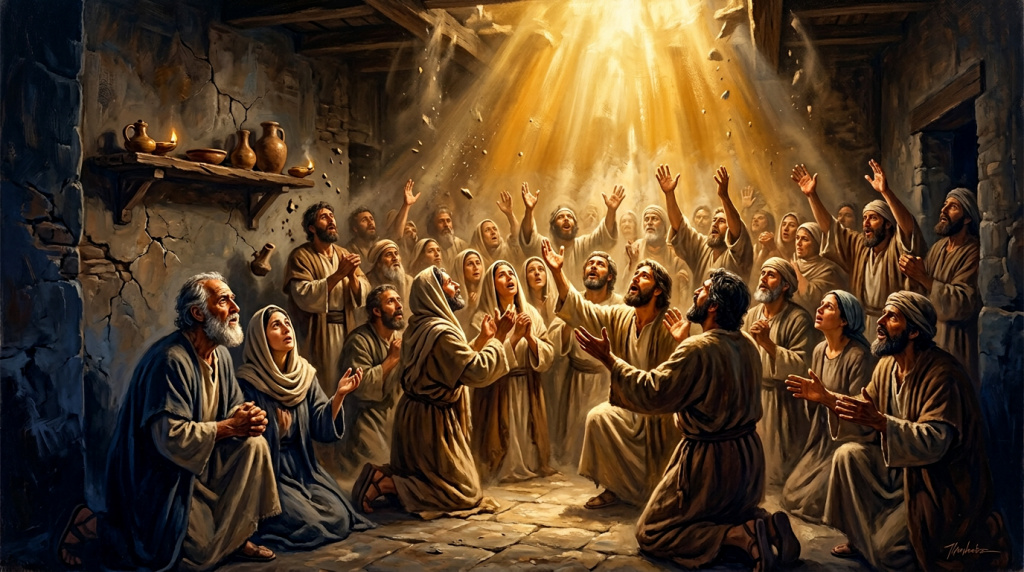
The public reading of Scripture is not a new thing. It is an old thing. In Nehemiah 8, when the walls were finally rebuilt and the exiles had finally come home, the people gathered as one in the square before the Water Gate and asked Ezra the scribe to bring the Book. He stood on a wooden platform, opened it in the sight of the people, and read from early morning until midday. And the people wept. They did not weep because the Bible had been read aloud. They wept because when the Word is opened, it opens us.
I still believe God’s Word does that. I believe it will do it this week. Wherever Scripture is read — with mixed motives or pure ones, by the faithful shepherd or the curious statesman — His Word does not return void. I am not too proud to believe God can speak through a televised Oval Office reading the way He spoke through a burning bush, a talking donkey, or a pagan king’s dream. If Scripture is elevated this week and even one soul is convicted, converted, or consoled, then we thank Him for it.
I also thank God, honestly, for the instinct behind the event. In a culture that often treats the Bible as a relic of a bygone worldview, the desire to stand up and declare this Book still matters is right. Civic leaders publicly submitting to a Book that is higher than they are — this is not a bad instinct. The Psalms are full of kings being told, in no uncertain terms, that they are not God.
So I rejoice. Truly. Wherever the Book is opened, I want to be the first to say amen.
Why I Tremble
But I would be a poor shepherd if I did not also speak honestly about what troubles me.
Because something can be good in one direction and dangerous in another. A hammer is a fine tool — and a terrible weapon if you swing it at the wrong person. The public elevation of Scripture is a good thing. But if Scripture is being elevated to serve another story — if it is being invited to the podium not to judge the nation but to bless the nation’s self-image — then we are standing on the edge of something far older than this week, and far more dangerous than any livestream.
Let me try to name it plainly.
The Bible was never meant to be a mascot.
It is not a prop for any country’s founding mythology. It is not a seal of approval for any political coalition. It is not a decorative flourish around the marble of our national memory. It is the living, active, God-breathed Word that judges the thoughts and intentions of every human heart — yours, mine, the senator’s, the president’s, the pastor’s, the influencer’s. When we reduce it to a civic ornament, we do not honor Scripture. We domesticate it. And a domesticated Bible is a betrayed Bible.
Here is what I am watching for this week, and what I ask you to watch for with me:
When “my people” in 2 Chronicles 7:14 gets quietly re-routed from the covenant people of God to the citizens of the United States, that is a misreading. Israel was not America. America is not Israel. The Church is the covenant people of the living God — “a chosen race, a royal priesthood, a holy nation, a people for his own possession” (1 Peter 2:9) — drawn from every tribe and tongue and nation. When we forget that, we do not get more biblical. We get less.
When Scripture is consistently paired with flags, founding documents, and partisan personalities, many of our neighbors — the very ones we are sent to love and to reach — hear a message we did not intend and the Bible never authorized: to belong with the Bible, you must belong with this tribe. That is not the gospel. That is a tribal symbol wearing a gospel coat.
And when the posture of our public faith drifts from prophetic witness to civic chaplaincy, we have quietly traded one calling for another. Paul tells us we are ambassadors for Christ (2 Corinthians 5:20) — representatives of a Kingdom that is not of this world, with citizenship issued from heaven itself (Philippians 3:20). An ambassador carries a message from another country. A chaplain blesses the one he is already in. The ambassador confronts. The chaplain comforts. Both have their moments — but the moment the ambassador becomes only a chaplain, the message from the other country stops getting through.
The Old, Old Trap
Friends, this is not new. It has a name and a long shadow.
I have written elsewhere about what I call the Constantinian Trap — the ancient, recurring temptation of the Church to exchange her cross-shaped witness for a throne-shaped seat at the table. Every generation, in every nation, gets a fresh invitation. Align with us, and we will give you influence. Bless our project, and we will make sure the Bible stays respected. It always sounds like victory. It almost always ends in compromise. The Bible ends up decorative. The pulpit ends up domesticated. And the watching world ends up confused about which kingdom the Church actually belongs to.
That trap does not require bad people. That is what makes it so dangerous. It only requires good people who have forgotten which country they are actually citizens of.
So What Do We Do?
I am not writing to tell you to turn off the livestream or to boycott the event. Watch it or don’t. Pray over it. Be glad where you can be glad.
But I am writing to ask you to hold on to three things this week, and beyond it.
First, keep Christ at the center. Not America. Not a movement. Not a party. Not a candidate. Not a coalition. The Book on the podium has a Person at its heart, and His Kingdom is not a subset of any earthly one. “My Kingdom is not of this world,” He told Pilate (John 18:36) — and Pilate was a far more powerful man than anyone reading Scripture in Washington this week.
Second, love your neighbor across the aisle. The Christian across the street who is watching every moment of this event with tears of joy is your brother or your sister. The Christian across town who is watching with grief and skepticism is also your brother or your sister. The neighbor who is not a Christian at all and is watching with suspicion is still made in the image of God and is still the one Jesus sent us to love. The gospel has room for all of them. The tribal version does not.
Third, read the Book yourself. Not as a prop for any project. Not as ammunition for any argument. Not as evidence in any culture war. Read it the way hungry people eat — because it is bread, and you are hungry. Read it until it reads you back. Read it until it comforts what needs comforting and confronts what needs confronting. Read it until America — and your own heart, and mine — shows up in its pages not as the hero, but as one more people who desperately need the God who is.
A Closing Word
I love this country. I truly do. I love our story, with its glories and its shame both held honestly. I want our leaders to read Scripture. I want our citizens to know it. I want revival in my bones and in our streets.
But I will not trade the Kingdom of God for the kingdoms of this world. I will not consent to a Bible used as a flag. I will not allow my pulpit, or my heart, or the people God has given me to shepherd, to be quietly recruited into any project that confuses the cross with any other banner.
We are not chaplains to a nation. We are ambassadors of a King.
And the Book being read this week is not ours to bless with. It is His, to bless us with — if we will let it read us before we try to read it for someone else.
So read it boldly this week. But read it as disciples. Read it as strangers and pilgrims. Read it as people whose deepest belonging is not to a flag but to a Lamb.
Grace and peace,
Pastor Chris