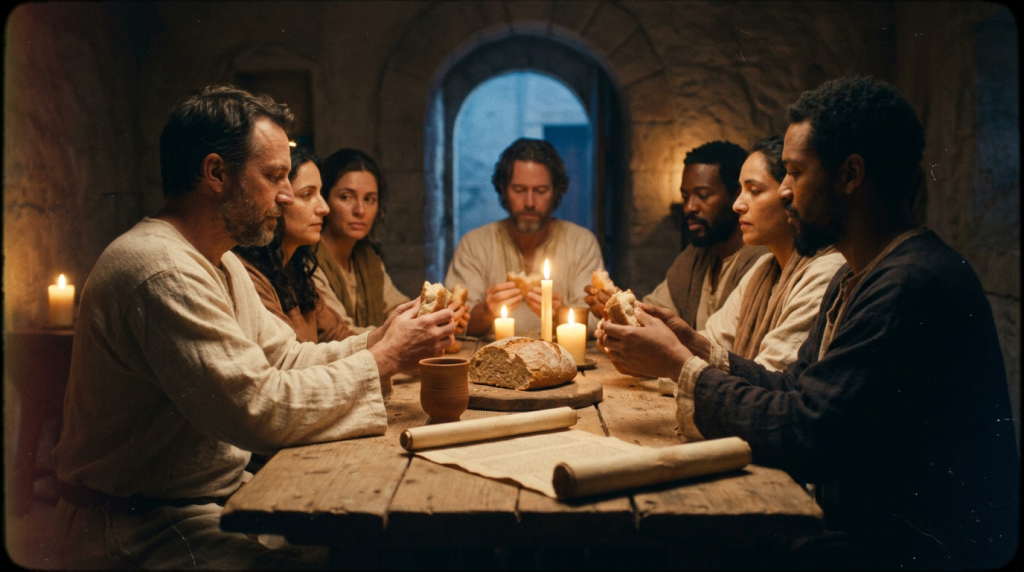

Generous Community: What Happens When a Church Becomes One Heart and Soul


This article is adapted from Sermon 11 in our forty-week expository journey through the Book of Acts.
What would it look like if a church truly shared everything?
Not in theory. Not as a slogan on a welcome banner. What if the people in a congregation actually cared so deeply about one another that no one among them was in need — because the moment a need appeared, someone stepped forward to meet it?
That is exactly what Luke describes in Acts 4:32–37. And it is one of the most beautiful — and most challenging — portraits of church life in the entire New Testament.
The Aftershock of the Spirit
This passage does not appear in a vacuum. It follows directly from last week’s text, where the church prayed for boldness and God shook the room. Acts 4:31 tells us they were all filled with the Holy Spirit and began to speak the word of God with boldness. Now, in verses 32–37, Luke shows us what Spirit-filled boldness looks like when it moves from the pulpit to the pocketbook.
The filling of the Spirit does not only produce bold preaching. It produces radical generosity. It creates a community where people hold their possessions loosely because they hold one another tightly. The same power that gave Peter courage before the Sanhedrin gave ordinary believers the freedom to open their wallets, sell their property, and lay the money at the apostles’ feet.
Boldness and generosity are not two separate fruits. They grow on the same vine.
One Heart and One Soul
Luke begins with a striking description in Acts 4:32: “And the congregation of those who believed were of one heart and soul; and not one of them claimed that anything belonging to him was his own, but all things were common property to them.”
Two phrases anchor this verse. First, they were “of one heart and soul.” This is not a polite agreement to get along. The Greek phrase conveys a deep, interior unity — a shared purpose, a common devotion, a single-minded commitment to Christ and to one another. These people had been transformed by the same gospel, filled by the same Spirit, and baptized into the same body. Their unity was not manufactured by programs or enforced by rules. It was produced by the Holy Spirit.
Second, “not one of them claimed that anything belonging to him was his own.” This does not mean they abolished private property. Luke is describing an attitude, not a political system. These believers still owned homes — the church met in homes throughout Acts. What changed was their relationship to their possessions. They stopped seeing their money, their land, and their goods as “mine” and started seeing them as resources God had entrusted to them for the good of the community.
This is one of the most countercultural sentences in the Bible. We live in a society that defines freedom as the right to accumulate and keep. The early church defined freedom as the joy of giving it away.
The Apostles’ Testimony and God’s Grace
Verse 33 adds a crucial detail: “And with great power the apostles were giving testimony to the resurrection of the Lord Jesus, and abundant grace was upon them all.”
Luke weaves two realities together: powerful preaching and generous living. The apostles proclaimed the resurrection with power, and grace rested on the entire community. These are not separate events. They are two expressions of the same Spirit-filled life. A church that preaches the resurrection boldly and shares its resources generously is a church where God’s grace is visibly, tangibly present.
The word “grace” here is the Greek charis — the same word used throughout the New Testament for God’s unmerited favor. Luke is saying that God’s favor was not just on the apostles. It was on the whole community. When a church lives in gospel unity and sacrificial generosity, God’s grace overflows in ways that everyone can see.
No Needy Person Among Them
Verses 34–35 describe the practical outworking of this grace: “For there was not a needy person among them, for all who were owners of land or houses would sell them and bring the proceeds of the sales and lay them at the apostles’ feet, and they would be distributed to each as any had need.”
That phrase — “there was not a needy person among them” — echoes Deuteronomy 15:4, where God promises Israel that if they obey His commands, “there will be no poor among you.” The early church was living out the Old Testament vision of a covenant community where God’s people care for one another so thoroughly that poverty is eliminated from within their fellowship.
Notice the mechanics. This was not a government program. It was not compulsory. It was voluntary, Spirit-led generosity. Property owners chose to sell their land and houses. They brought the money to the apostles. The apostles distributed it according to need. The giving was sacrificial, the process was orderly, and the result was that no one went without.
This is what the gospel does to a community. It does not just change what we believe. It changes what we do with what we have.
Barnabas: A Portrait of Gospel Generosity
Luke closes this passage by introducing us to a man named Joseph, whom the apostles called Barnabas — a name meaning “Son of Encouragement.” He was a Levite from Cyprus who owned a field, sold it, and brought the money to the apostles.
Barnabas appears here for the first time, but he will become one of the most important figures in the book of Acts. He will later vouch for the newly converted Saul when the other apostles are afraid of him. He will travel with Paul on the first missionary journey. He will become a pillar of the early church’s mission to the Gentiles.
And Luke introduces him through an act of generosity.
That is not an accident. The first thing we learn about Barnabas is not his theology, his preaching, or his leadership ability. It is his willingness to give. His character is revealed through his open hand. The name the apostles gave him — Son of Encouragement — was earned not by his words but by his wallet.
Barnabas shows us that encouragement is not just something you say. It is something you do. Every dollar given, every meal provided, every bill paid, every need met — these are acts of encouragement that preach the gospel louder than any sermon.
A Moment for Reflection
1. Am I holding my possessions with an open hand or a clenched fist? The early believers stopped claiming that what they owned was theirs alone. How tightly are you holding onto your money, your house, your time? What would it look like to see them as resources entrusted to you by God for the good of others?
2. Is there a need in my church or community that I could meet this week? Luke says there was not a needy person among them — because people stepped forward. Do you know someone in your church family who is struggling financially, physically, or emotionally? What would it cost you to step forward?
3. Do I give out of obligation or out of joy? The generosity in Acts 4 was not compulsory. It was the overflow of Spirit-filled hearts. If giving feels like a burden rather than a privilege, ask God to renew your heart and show you the joy of generosity.
4. Would people describe me as an encourager? Barnabas was known as the “Son of Encouragement” because of his generosity. What are you known for? What name would the people in your life give you based on how you treat them?
Suggested Scripture Readings for the Week
Monday: Acts 4:32–37 — Read the full passage slowly. Notice the connection between unity, generosity, and grace.
Tuesday: Deuteronomy 15:1–11 — God’s vision for a community where there is no needy person. See the echo in Acts 4:34.
Wednesday: 2 Corinthians 8:1–9 — Paul holds up the Macedonian churches as a model of sacrificial generosity, rooted in the grace of Christ.
Thursday: 2 Corinthians 9:6–15 — “God loves a cheerful giver.” Generosity as worship.
Friday: Luke 12:13–34 — Jesus teaches about the danger of greed and the freedom of trusting God with your possessions.
Saturday: 1 John 3:16–18 — “Let us not love with word or with tongue, but in deed and truth.”
Sunday: Philippians 2:1–11 — The ultimate model of self-giving: Christ, who emptied Himself for us.
Your Call to Action This Week
1. Give something sacrificially. Not out of your surplus. Out of your substance. Choose one act of generosity this week that costs you something — an amount that makes you trust God a little more. Give it to a person, a family, or a ministry where the need is real.
2. Meet one specific need. Find out if someone in your church family needs groceries, help with a bill, a ride to an appointment, or a meal. Do not wait to be asked. Ask, and then act. The early church did not have a complicated system. They simply saw need and met it.
3. Practice saying “ours” instead of “mine.” This week, every time you think about your money, your house, your car, or your time, try replacing “my” with “God’s” or “ours.” It is a small shift in language that can produce a profound shift in heart.
4. Encourage someone the way Barnabas did. Send a text, write a note, buy someone coffee, pay for someone’s meal, or cover a bill anonymously. Let your generosity be your encouragement. Be a Barnabas to someone this week.
You’re Invited
Join us this Sunday, May 24, 2026, at 11:00 AM as Pastor Chris Carter continues our journey through the book of Acts with “Generous Community: One Heart and Soul” from Acts 4:32–37.
Priceville Baptist Church 713 North Feemster Lake Road | Tupelo, Mississippi 38804
If you have ever wondered what it would look like for a church to truly live as one family — sharing, serving, giving, and caring for one another — this passage is the blueprint. Come see what God can do when His people hold their possessions loosely and hold one another tightly.
For deeper study during the week, listen to The Holy Defiance Podcast, Episode 11 — “Generous Community: One Heart and Soul” — for expanded teaching, reflection, and practical application tied directly to this Sunday’s sermon.
This article is part of our weekly blog series accompanying “A Forty-Week Journey Through the Book of Acts — The Birth and Expansion of the Church” at Priceville Baptist Church. New articles are published each week to help you prepare for Sunday worship and apply God’s Word throughout the week.